
TL;DR
- Ticker: 1375 (TSE Prime)
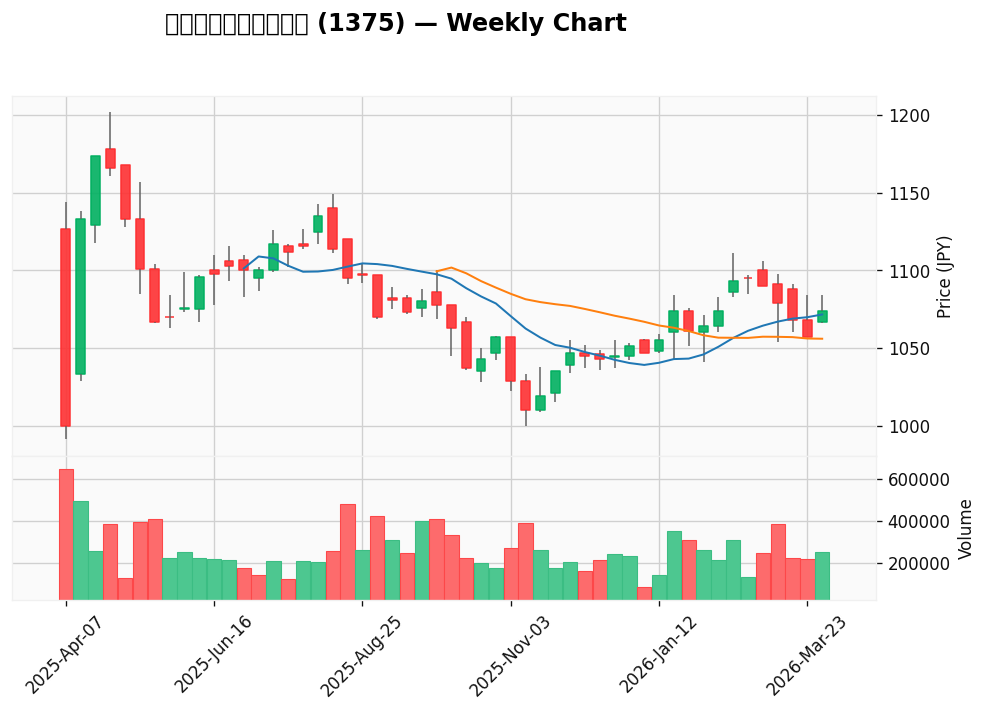
- Entry Price: ¥1,074 | Market Cap: ¥42.86B
- NCAV Ratio: -0.50x | Net Cash Ratio: -0.50x
- Screen Result: DOES NOT QUALIFY (fails NCAV test; revenue CAGR data unavailable; passes operating profit test only)
- Thesis: This is a value trap, not a net-net. The company is levered to its eyeballs with negative tangible book value. I’m passing.
About the Business
YUKIGUNI FACTORY operates in the Fishery, Agriculture & Forestry sector (classified as FOODS in the broader 17-sector taxonomy). Based on the company name and sector classification, I infer this is a food processing or agricultural products manufacturer, likely positioned in Japan’s primary industries. However, I want to be direct about what I don’t know: the fact sheet provides no details on specific manufacturing facilities, production capacity, product mix, or geographic footprint. The company’s recent IR disclosures are listed as unavailable, which is a yellow flag in itself — silence from small-cap management often signals either benign neglect or active avoidance of uncomfortable conversations with investors.
What I do know is this: YUKIGUNI FACTORY’s balance sheet is deeply underwater in economic terms, and that’s the story that matters here.
Valuation Gap
Let me be precise about the distinction between these metrics, because it’s critical to understanding why this stock fails my investment screen.
Net Cash is the most conservative measure of financial health:
$$Net\ Cash = (Cash\ \&\ Equivalents) – Total\ Liabilities$$
For YUKIGUNI FACTORY:
– Cash & Equivalents: ¥3.90B
– Total Liabilities: ¥25.34B
– Net Cash: -¥21.44B
This is negative. The company owes ¥21.44B more than it has in cash. That’s devastating.
NCAV (Net Current Asset Value) takes a slightly different approach:
$$NCAV = Current\ Assets – Total\ Liabilities$$
For YUKIGUNI FACTORY, the NCAV is also -¥21.44B — which tells me that current assets alone cannot cover total liabilities. The company is insolvent on a balance-sheet basis.
The NCAV Ratio compares this to market cap:
$$NCAV\ Ratio = \frac{-21.44B}{42.86B} = -0.50x$$
To put this in Graham-era language: the market is paying ¥42.86B for a company with negative tangible book value. By any classical net-net definition, this is not a bargain — it’s a company that should theoretically be worth far less, or possibly zero, if liabilities exceed all liquidation value of assets.
Why does the discount exist? This is the question I need to answer. In my experience with small Japanese food companies, there are three possibilities:
-
The company has substantial unrealized gains embedded in owned real estate or biological assets (agricultural land, fishing rights) that are carried at depressed book values. Management is simply not communicating this clearly, and the market has given up trying to figure it out.
-
The debt is tolerable because the company generates steady operating cash flow that services it — and the market is pricing this as a going concern, not a liquidation.
-
It’s a genuine value trap: liabilities will grow, operations will decline, and equity holders will be wiped out in a restructuring.
I have insufficient data to rule out any of these. That’s problem number one.
Financial Trends
Here’s what the latest financial data shows:
| Metric | 1 Year Ago | Latest | Change |
|---|---|---|---|
| Revenue | ¥47.48B | ¥53.14B | +11.9% |
| Operating Profit | ¥2.81B | ¥2.42B | -13.9% |

Revenue is growing — up nearly 12% year-over-year. That’s positive. The company is not in sales free-fall.
But operating profit is declining — down 13.9% despite higher revenues. This is the red flag. Operating margin is contracting. Either input costs are rising faster than selling prices, or the company is investing heavily in growth without yet seeing profitability returns, or both. I don’t have the gross margin or cost-of-goods-sold data to diagnose which.
The EPS forecast (¥nan) is unavailable, which means either the company hasn’t provided guidance or J-Quants cannot compute it — likely due to the negative equity situation. This is another silence.
What I want to know but don’t: Is operating profit expected to stabilize? Will margin pressure ease? Is the debt burden sustainable at current profitability levels? No recent IR disclosures means I have no answers.
Catalysts
I’m struggling to identify concrete catalysts here, and that’s honest feedback to myself. Potential catalysts would include:
-
A strategic announcement — asset sales, debt restructuring, or a merger that would reduce leverage and restore positive tangible book value. Given the absence of recent IR activity, I see no signals of this.
-
Margin stabilization — if the next earnings release shows operating profit stabilizing or recovering, it would suggest that the revenue growth is sustainable and profitability is not in structural decline. That would improve the going-concern case.
-
Sector tailwinds — if Japan’s agricultural or fishery sector undergoes consolidation or faces supply-side tightening (reducing competition and improving pricing), YUKIGUNI FACTORY could benefit. But I have no data on sector dynamics here.
-
Management activism — a new CEO or board overhaul that signals a commitment to reducing debt and unlocking hidden asset value. Again, no signals.
The absence of catalysts is itself a catalyst: if nothing material changes in the next 6–12 months, the stock will likely remain a speculative hold for distressed-debt investors or merger arbitrageurs, not value investors like me.
Risks
-
Liquidity Risk: YUKIGUNI FACTORY is a small-cap stock in Japan (TOPIX Small 2 classification). Trading volume is likely thin. If I wanted to build even a 1% portfolio position, I could move the price significantly on entry and would face difficulty on exit in a market downturn.
-
Value Trap Risk: The classic danger. The stock is cheap for a reason. Negative tangible book value often precedes equity wipeouts in restructurings. I could be catching a falling knife.
-
Margin Deterioration Risk: Operating profit is already declining despite revenue growth. If this trend continues, the company could shift from marginally profitable to unprofitable, which would accelerate a potential debt spiral.
-
Debt Covenant Risk: I don’t have access to the debt covenants, but a company with ¥25.34B in liabilities against ¥12.53B in equity is likely constrained. A covenant breach could force restructuring or asset sales on unfavorable terms.
-
Information Risk: No recent IR disclosures is not neutral — it’s a negative signal. It suggests either management indifference to shareholder communication or intentional opacity.
Final Verdict
I am passing on YUKIGUNI FACTORY. It does not meet my three-point screen (fails the NCAV test decisively; revenue CAGR data unavailable; passes operating profit only). More importantly, it fails my qualitative bar for a value investment: I cannot construct a coherent thesis for why the market is mispricing this company, and I cannot identify a clear catalyst that would close the gap between book and market value.
The combination of negative tangible book value, declining operating margins, and management silence suggests a value trap, not an opportunity. I’d rather wait for a company with positive net cash, stable margins, and active management communication.
Watchlist Status: I’ll monitor quarterly earnings releases over the next two quarters. If operating profit stabilizes at or above ¥2.4B and management publishes a debt-reduction roadmap, I’ll reconsider. Until then, this stock remains on my “avoid” list.
Generated from research note dated 2026-03-30. This is a personal investment analysis for informational purposes only, not financial advice. Small-cap Japanese stocks are illiquid and volatile. Do your own due diligence.